You’re not a Stanford dropout who can start with the solution, get VC money and find people to buy it later.
Before you write a single line of code, you need to answer a question: “What problem am I trying to solve with AI?”. We’re living through an AI hype cycle where every day someone announces they’re “adding AI” to their product. These announcements sound impressive but solve no real problems. They’re building AI for the sake of AI, which is backwards.
AI is a tool, not a magic wand. Like any tool, it’s good for specific jobs and terrible for others. You wouldn’t use a hammer to cut wood or a saw to drive nails (maybe you would if it meant getting that sweet VC money but let’s ignore this since we’re not Stanford dropouts).
You’ll see way too many people approach AI development by starting with:
"What can AI do?" → Find problems to fit the technology
This backwards thinking is why your projects fail. The right approach flips this around completely. The difference between building something people want and building something impressive is actually solving a problem instead of just trying to do something cool.
Let’s analyze problems and understand what’s actually worth solving.
TL;DR
- Start with real problems people have, not what AI can do
- High pain + frequent problems = actual market opportunity
- Talk to users before building anything (revolutionary, I know)
- AI should improve existing solutions, not create new problems to solve
The Problem Hierarchy
Not all problems are created equal. Some problems are painful and people actively seek solutions. Others are minor annoyances that people complain about but don’t actually act on.
You should understand two dimensions: pain intensity and frequency of encounter. Problems that cause real pain and occur frequently create the strongest market opportunities because they motivate people to actively seek solutions and change their behavior.
High-pain, frequent problems like financial stress or team communication breakdowns drive people to spend money, invest time learning new tools, and switch from existing solutions. The combination of urgency and repetition creates sustained demand that can support businesses.
Low-pain, infrequent problems like digital decluttering or password updates rarely motivate behavior change. People might acknowledge these as problems, but they develop workarounds or simply tolerate the inconvenience rather than seeking dedicated solutions.
Let’s take a look at this in a structured way:
| Problem Type | User Behavior | Market Potential | Examples |
|---|---|---|---|
| High Pain + Frequent | Actively seek solutions, willing to pay | Excellent | Financial stress, communication tools |
| High Pain + Infrequent | Seek solutions when needed | Good | Tax preparation, legal advice |
| Low Pain + Frequent | Develop workarounds | Limited | Email organization, photo sorting |
| Low Pain + Infrequent | Ignore or tolerate | Poor | Digital decluttering, password updates |
The top row creates businesses. The bottom row creates demos that impress nobody except other developers. What looks like a problem on the surface might not be one that people care enough to solve.
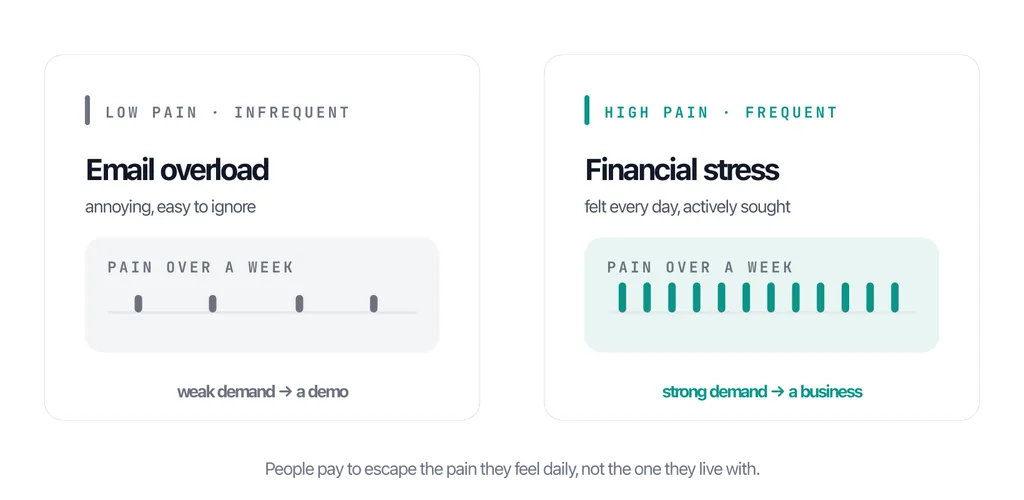
Take email organization as an example. Everyone complains about email overload, so building an AI-powered email organizer seems like a no-brainer. But when you dig deeper, you discover that people have developed coping mechanisms that work well enough. They’re not actively seeking a solution because the problem, while annoying, doesn’t cause enough pain to motivate change.
Personal finance management represents a different category entirely. Financial stress affects people and has serious consequences. People make spending decisions every day, they need to check in on their finances regularly, and they’re constantly planning for the future. The problem never goes away, and the stakes are high enough that people actively seek solutions.
Unless you have a bunch of money to use on research, your best bet isn’t asking “What can we do with transformers?”, it’s asking “What problems do people have that we might be able to solve better?”. There’s an even better way to validate if a problem is worth solving though, and that’s what we’ll see next.
Validation Through Current Behavior
The best way to validate that you’ve identified a real problem is to focus on current behavior rather than hypothetical preferences.
Don’t ask: “Would you use an AI tool for X?”
Instead ask:
- How do you currently handle X?
- What’s frustrating about that process?
- What workarounds have you developed?
- How much time or money do you currently spend dealing with this?
Look for existing solutions as a positive signal. If multiple competitors have paying customers, that’s evidence of real demand. If no one else is trying to solve the problem, that might be a red flag rather than an opportunity.
People want problems solved - they don’t care about the underlying technology. The “AI-powered” part isn’t a selling point unless it enables capabilities that weren’t possible before. And more on that, AI isn’t always the answer as we’ll see next.
Always Try the Simple Solution First
Before committing to an AI approach, you should seriously consider whether simpler solutions might work better. Adding AI complexity to your application has real costs - development time, operational complexity, unpredictable behavior, and ongoing maintenance. Sometimes the best AI solution is no AI at all.
To evaluate if AI (generative AI especially) is a good fit, ask yourself these questions:
| Question | AI Favored | Simple Solution Favored |
|---|---|---|
| Could rule-based logic solve this? | No - too many edge cases | Yes - clear if-then rules work |
| Is natural language understanding needed? | Yes - users need conversational interface | No - structured inputs work fine |
| Do you need personalization? | Yes - responses must adapt to individuals | No - one-size-fits-all works |
| How important is explainability? | Moderate - approximate reasoning OK | Critical - exact logic required |
| What’s the precision requirement? | Mixed - some approximation acceptable | High - zero tolerance for errors |
This framework helps you actually decide rather than jumping to AI because it seems impressive. Now let’s see how to apply this to a real example.
Learning Through a Real Example
Throughout this series of blog posts, we’ll work through a concrete example: building a Personal Finance Assistant. This isn’t a toy example - it’s a real problem that affects millions of people and represents a business opportunity (there’s definitely someone making money with this exact idea).
Personal finance makes a good case study because it’s a problem that people struggle with daily. Managing finances, understanding spending patterns, and making informed financial decisions cause real stress and have serious consequences. The problem has clear AI benefits - natural language understanding, pattern recognition, and personalized recommendations are what LLMs do well. Financial services represents a large market with proven willingness to pay for valuable tools (you’re paying to save money), and the complexity scales so we can start simple and add sophisticated features as we learn.
As we work through this example, you’ll see how to apply the same thinking process to your own problem domain. The specific details will be different, but the fundamental approach works for any AI application.
Start with “What problems do people actually have?” and determine when AI is the right solution. This approach leads to applications that people actually want to use and pay for, rather than impressive demos that nobody needs.
The specific details will be different for your domain, but the fundamental approach works for any AI application.
In our next post, we’ll talk a bit about what we even mean by “AI”, and LLM capabilities. Where they should actually be used. Subscribe to the Newsletter and stay tuned.
Get started with FastroAI - the fastest way to build production-ready AI applications that solve real problems.