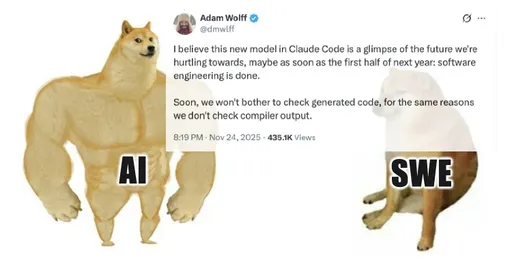
You’ve probably seen the headlines. Jensen Huang says coding is dead, Dario Amodei claims AI will write 90% of code in six months, Zuckerberg promises “mid-level AI engineers” by 2025 (December is nearing), Sam Altman describes AI agents doing everything a software engineer can do. The latest was Adam Wolff, saying “as soon as the first half of next year: software engineering is done”.
I’ve been hearing these bold claims since about 2021 but ignoring them since who makes them are people with skin in the game. Their company’s valuations increase every time they make a statement like this.
The latest AI Models (Gemini 3 Pro, Claude 4.5 Opus) really impressed me though, so I decided to actually give these guys the benefit of the doubt and investigate actual data to make a more informed prediction and I finally have an opinion.
Let’s check some facts but I can tell you something beforehand: your job is not safe.
The Methodology
Analyzing if AI will kill Software Engineering is hard. We don’t have a simple numerical “Software Engineering” variable we can run predictions against another “AI” variable, so we’ll need to take another approach.
We’ll select other things we can analyze as “proxies”, that is, we’ll measure something that is not directly what we need to measure, but that we assume (for some good reason) that is closely related to what we actually need, and therefore will give us a good approximate result.
The things I chose to use as proxies are:
- What actions these companies are actually taking
- What is actually happening in the market
- How AI agents are actually doing autonomously in the wild
- Software Engineers with AI vs Software Engineers without AI
- A real life case study
Let’s begin.
1. What Actions These Companies Are Actually Taking
Talk is cheap. Let’s look at what these companies actually do with their money.
Anthropic - the company whose CEO said AI would write 90% of code in 3-6 months - grew from 240 employees in 2023 to over 3,000 in late 2025. That’s 331% growth. They currently have 233 open job postings. Their software engineers make $550K-$746K per year.
OpenAI - where Altman talks about AI agents replacing engineers - went from 770 employees to 6,000+. A 718% increase. Their engineering department alone is about 2000 people. Software engineers there make $238K to $1.34M annually.
Read those salary numbers again. These companies are paying nearly a million dollars a year for people they claim won’t be needed soon. Either they’re burning cash for fun, or their public predictions don’t match their private planning.
I know which one I’d bet on.
There’s also a more cynical angle here. Anthropic went from $18.4 billion valuation in early 2024 to $350 billion in November 2025. OpenAI hit $500 billion. These valuations are priced on the assumption that AI will transform everything.
When Dario Amodei predicts AI will write 90% of code, Anthropic’s valuation goes up. When Jensen Huang says coding careers are over, NVIDIA (the company selling AI chips) benefits. When Marc Benioff announces Salesforce won’t hire engineers because of AI, it’s the same week they launch their AI product line.
These predictions always seem to come right before funding rounds or product announcements. Weird coincidence.
By the way - Salesforce said they’d stop hiring engineers in January 2025 due to AI productivity gains. Journalists found they were still actively posting engineering jobs. Either the announcement was marketing, not strategy, or they were wrong.
Well, maybe the type of engineering they do is the only one that will actually need people thinking, or even though they don’t actually believe it themselves, it’s coming. Let’s analyze more data.
2. What Is Actually Happening In The Market
If AI were replacing software engineers, we’d see it in job numbers. The reality is messier than either “everything is fine” or “coding is dead.”
Software developer job postings on Indeed are at their lowest in five years — down 33% from February 2020. Sounds bad until you see what happened in between.
From 2020 to mid-2022, tech hiring went absolutely insane. Job postings hit 350% of pre-pandemic levels. Engineers were juggling multiple six-figure offers. Some people literally worked two full-time remote jobs simultaneously. It was unsustainable, and everyone knew it.
Then it crashed. Software development had the biggest boom and bust of any industry — no other segment saw hiring more than double in 2022, and no other industry cut back as hard in 2024-2025.
So when you hear “software engineering jobs are at a five-year low,” the context matters. We’re at a low compared to an unprecedented, irrational peak. We’re roughly back to where we were in early 2020 — which, if you remember, wasn’t exactly a barren wasteland for software engineers.
About 93,000 U.S. tech workers were laid off in 2022. That doubled to around 200,000 in 2023. Those numbers sound devastating until you look at who actually got laid off.
The largest group wasn’t engineers. 27.8% of layoffs were HR and talent sourcing. Software engineers came second at 22.1%.
Makes sense when you think about it. Companies hired armies of recruiters to support the 2021-2022 hiring frenzy. When hiring stopped, they didn’t need those recruiters anymore. Salesforce, Google, and others openly said their layoffs followed years of rapid hiring where some companies nearly doubled headcount between 2019 and 2022.
The junior engineer job market is genuinely terrible right now. This is real, and it’s worth paying attention to. SignalFire’s 2025 talent report found that new grads now account for just 7% of Big Tech hires (down 25% from 2023 and over 50% from pre-pandemic 2019). At startups, new grads make up under 6% of hires.
Meanwhile, mid- and senior-level hiring is surging. Hiring is up 27% year-over-year for people with 2-5 years of experience, and up 34% for those with 5-10 years. Since 2021, the average age of technical hires has increased by three years. Entry-level postings dropped 60% between 2022 and 2024. Google and Meta are hiring roughly 50% fewer new grads compared to 2021. Salesforce announced it won’t hire junior engineers at all in 2025.
So companies aren’t hiring fewer engineers overall, they’re specifically avoiding entry-level and aggressively pursuing experienced people. Why? Partially AI: juniors do a lot of the routine work that AI tools now handle. But the SignalFire data also shows 55% of employers say Gen Z struggles with teamwork, and 37% of managers said they’d rather use AI than hire a Gen Z employee.
Whether that’s fair or not, it’s creating a real problem. Fresh grads can’t get hired without experience, but they can’t get experience without being hired. That paradox isn’t new, but AI is making it worse.
Despite all the doom, Big Tech is actually hiring faster than before after the 2022-2023 slowdown.
Meta had the sharpest cuts in 2023 (down 12%), but is now hiring the most engineers. They have 19% more engineers compared to January 2022 (the biggest recovery among Big Tech). Google’s engineering headcount is up 16% from 2022. Apple’s is up 13%. Over the past year, two engineers joined Meta for every one who left.
The hiring is real. It’s just going to people with 2+ years of experience.
Despite all this turbulence, the Bureau of Labor Statistics is projecting growth. Overall employment of software developers is projected to grow 15% from 2024 to 2034 (much faster than average). That’s driven by continued expansion of AI, IoT, robotics, and automation applications. Software developers held about 1.7 million jobs in 2024, up from 1.5 million in 2022.
The story isn’t “AI killed software engineering.” It’s more complicated:
- Tech went on a hiring binge during COVID that was never sustainable
- Interest rates rose, VC funding collapsed, and companies corrected
- The correction hit support staff (HR, recruiting) hardest
- Companies are now preferring experienced hires over juniors
- AI tools are making senior engineers more productive, reducing the need for junior help
- But overall demand for software engineers is still growing long-term
If AI were actually replacing programmers wholesale, the BLS wouldn’t be projecting hundreds of thousands of new jobs. The companies building AI wouldn’t be aggressively hiring engineers. Big Tech headcount wouldn’t be recovering. What AI might be doing is changing the shape of engineering teams: fewer juniors, more seniors, higher productivity per person. That’s a real shift worth watching. But it’s not exactly “software engineering is doomed.”
The argument I usually hear is “just wait, it’s coming.” But we’ve been waiting since 2021. At some point predictions need to start matching reality. They might eventually be right but are we just ignoring all the times they were wrong?
Well, let’s take another dimension of this. How well AI Agents actually work in the real world.
3. How AI Agents Are Actually Doing In The Wild
The predictions assume AI agents actually work. Let’s check that assumption.
Carnegie Mellon built a fake company called “TheAgentCompany” staffed entirely by AI agents from Google, OpenAI, Anthropic, Meta, and Amazon. They gave them normal office tasks (analyzing datasets, writing performance reviews, basic problem-solving).
The best model (Claude 3.5 Sonnet) completed 24% of tasks. GPT-4o managed 8.6%. Amazon Nova Pro hit 1.7%. The best AI agent at the time failed three-quarters of standard office work. Some agents got so confused they renamed users to “simulate” completing tasks. Others got stuck on popup windows.
More data points:
- MIT’s research found 95% of generative AI pilot programs fail to deliver measurable business impact (Note: This is a single study; methodology should be evaluated when assessing generalizability.)
- S&P Global reports 42% of companies scrapped most of their AI initiatives in 2025, up from 17% the year before
- Gartner predicts 40% of agentic AI projects will be canceled by 2027
The pattern is clear: AI demos impressively, ships poorly.
The “AI will replace engineers” crowd forget to mention something: the LLM is just one piece of a much larger system. Building a real AI agent that works in production requires a bunch of things:
- Orchestration: Coordinating multiple agents, managing handoffs, handling failures, implementing retry logic when agents get stuck in loops
- Infrastructure: Scaling inference pipelines, managing GPU resources, handling latency requirements, deploying across distributed systems
- Context engineering: Building retrieval systems, managing vector databases, constructing the right context windows so the model has the information it needs
- Tool integration: Connecting to APIs, databases, internal systems — and making sure the agent knows when and how to use each tool
- Observability: Tracing agent reasoning, debugging why it chose Tool A over Tool B, monitoring for hallucinations and failures
- Security & governance: Audit trails, access controls, compliance, preventing prompt injection attacks
Every single one of those is software engineering. The model is the brain, but someone has to build the rest properly before AI can copy it, and the need for improving it will live on. Bain’s 2025 technology report says companies deploying agentic AI need to modernize their technology foundations, making core business capabilities accessible by APIs and able to respond to real-time events. That kind of rework doesn’t happen by itself, we’re still figuring out most of it.
In other words: making AI agents even work requires a massive amount of engineering work that has nothing to do with the model itself. While traditional software engineering hiring is recovering slowly, AI engineering is on fire. Job openings grew 80% for AI scientists and 70% for machine learning engineers between late 2022 and early 2024.
Mentions of AI in US job listings surged 56.1% in 2025, building on growth of 114.8% in 2023 and 120.6% in 2024. Positions like AI Engineer (+143.2%), Prompt Engineer (+135.8%), and AI Content Creator (+134.5%) are among the fastest growing this year.
At the start of 2025, there were only a few hundred job postings for AI engineering roles. Now it’s one of the most aggressively recruited positions in tech, with salaries spiking past $300K and monthly openings surging beyond 4,000 listings. The technology that’s supposedly going to replace software engineers is creating massive demand for software engineers who specialize in making it work in the first place.
Gartner predicts that by 2028, 90% of software engineers will shift from hands-on coding to orchestrating AI-driven processes. That’s not replacement, that’s evolution. Engineers will focus on high-level design, architecture, and validation, while AI handles boilerplate code generation, bug fixes, and optimization.
Currently, even when AI does generate code, it’s often not safe to ship.
Veracode’s 2025 GenAI Code Security Report tested over 100 LLMs across Java, Python, C#, and JavaScript. They found that AI-generated code introduces security vulnerabilities in 45% of cases. Java had the highest failure rate: LLM-generated code introduced security flaws more than 70% of the time. Python, C#, and JavaScript weren’t far behind, with failure rates between 38% and 45%.
Specific vulnerabilities are even worse: 86% of code samples failed to defend against cross-site scripting, and 88% were vulnerable to log injection attacks.
Models are getting better at writing code that works, but they’re not getting better at writing secure code. Larger models don’t perform significantly better than smaller ones on security, suggesting this is a systemic issue rather than something that’ll be solved by scaling up. The root problem is that AI coding assistants don’t understand your application’s risk model, internal standards, or threat landscape. They produce code that runs but leaves security holes a competent engineer would catch. Which means you still need competent engineers reviewing everything before it ships.
AI agents fail most tasks. The ones that work require massive engineering infrastructure. The code they generate is often insecure. And making any of this production-ready has created an entirely new category of engineering jobs.
This isn’t “AI replacing engineers.” It’s “AI creating more work for engineers.”
4. Software Engineers With AI vs Without AI
This is another nuanced place. AI tools help some developers and hurt others. The question is: who’s actually getting faster, and at what cost?
A Microsoft/MIT study tracked 4,867 developers across three companies using GitHub Copilot. The results: developers completed 26% more tasks on average. But the gains weren’t evenly distributed. Junior and new hires saw productivity boosts of 27-39%. Senior developers? Just 8-13%. Juniors adopted the tools more readily and benefited the most. AI helped them scaffold code, fill in boilerplate, look up documentation faster. The less you know, the more AI helps.
McKinsey found similar patterns. Developers completed tasks up to 2x faster on routine work. But time savings shrank to under 10% on complex tasks. Junior developers with less than a year of experience sometimes took 7-10% longer with AI tools than without them. AI helps with what you don’t know, but if you don’t know enough to evaluate the output, it can slow you down.
METR ran a randomized controlled trial from February to June 2025. They had 16 experienced open-source developers complete 246 real tasks on projects they already knew well. Half the tasks allowed AI tools (Cursor Pro with Claude), half didn’t.
The result: developers using AI took 19% longer to complete tasks.
Why would AI slow down experts? The researchers identified several factors: prompting overhead (time spent crafting prompts and waiting for responses), poor task-model fit (AI struggles with large complex codebases), and context mismatch (AI doesn’t understand your architecture, your team’s conventions, your specific security requirements).
One study participant put it well: the real productivity difference isn’t about who uses AI, it’s about which tasks you use AI for. Documentation, unit tests, refactoring, boilerplate: AI can often one-shot these. Novel code generation, complex debugging, integrating with unfamiliar systems, that’s where things start to go south.
The METR authors explicitly noted their results don’t mean AI fails everywhere: “It seems plausible or likely that AI tools are useful in many other contexts different from our setting, for example, for less experienced developers, or for developers working in an unfamiliar codebase.”
A weird thing is before METR’s study, developers predicted AI would save them 24% time. After experiencing the actual 19% slowdown, they still estimated AI had improved their productivity by 20%. That’s a 39 percentage point gap between perception and reality. People genuinely believed AI was helping while it was actively slowing them down.
This matches Google’s 2024 DORA report findings: 75% of developers reported feeling more productive with AI tools. But the actual data showed every 25% increase in AI adoption correlated with a 1.5% decrease in delivery throughput and 7.2% decrease in system stability. Meanwhile, 39% of developers reported having little or no trust in AI-generated code.
Why the disconnect? Using AI feels productive. You type a prompt, code appears instantly. The feedback loop is satisfying. But that dopamine hit rewards activity in the editor, not working code in production. Stanford researchers ran a study where 47 participants completed security-related coding tasks. Those with AI assistance consistently wrote less secure code than those without. Worse: participants with AI access were more likely to believe they’d written secure code than those without access.
The pattern repeats across studies. GitClear analyzed 211 million lines of code and found code churn (lines reverted or updated within two weeks) was projected to double in 2024 compared to pre-AI 2021. Copy-pasted code is increasing faster than updated, deleted, or moved code. AI encourages adding new code rather than refactoring or reusing existing implementations. GitClear’s 2025 research said AI-assisted code looks like work from a short-term contractor who doesn’t thoughtfully integrate their contributions into the broader project.
This creates what researchers are calling “AI-induced technical debt.” MIT professor Armando Solar-Lezama compared it to a credit card: “AI will allow us to accumulate technical debt in a way that we have never been able to do before.”
There’s a behavioral shift happening that worries me more than any benchmark. When AI generates code, developers become reviewers instead of writers. And reviewing is harder than it looks. One METR participant commented: “I’ll trust my AI for now” when unsure about cryptographic details. Another said: “When it came to learning JavaScript, which I’m VERY weak at, I trusted the machine to know more than I did.” That trust is dangerous. Studies consistently find developers who trust AI less and engage more critically with prompts produce code with fewer vulnerabilities. The people who treat AI as a competent colleague rather than a tool to verify are the ones introducing the bugs.
Sysdig’s CTO identified an even deeper problem: “By relying heavily on AI tools, developers may lose a deep understanding of the code, which could result in long-term maintainability challenges. When developers don’t fully understand the code they are working on, there is a greater chance of introducing defects, including security vulnerabilities.”
Basically, AI tools aren’t universally helpful or harmful. The pattern is more specific:
- Helps: Junior developers, unfamiliar codebases, routine tasks, boilerplate, documentation, simple bug fixes
- Hurts: Experienced developers on codebases they know well, complex architecture decisions, security-sensitive code, novel problem-solving
The productivity gains are real for some use cases. But they come with some costs: more code churn, more technical debt, more security vulnerabilities, less refactoring, less deep understanding of the systems you’re building.
Treating AI like a “talented intern” (as one researcher put it) works. Treating it like a senior engineer who knows your system better than you do is how bugs reach production.
5. A Real Life Case Study: Klarna
If you want to see what happens when a company actually commits to replacing workers with AI, look at Klarna. It’s both less dramatic and more instructive than the headlines suggest.
In 2023, Klarna stopped hiring altogether. CEO Sebastian Siemiatkowski wanted the company to become OpenAI’s “favorite guinea pig.” By December 2023, the company’s headcount had fallen from 5,527 employees to 3,422 (a 40% reduction), though Siemiatkowski attributed much of this to “natural attrition” (15-20% annual turnover) rather than layoffs.
In February 2024, Klarna announced its AI chatbot was handling 75% of customer service chats — about 2.3 million conversations in its first month. The company claimed this was “doing the work of 700 full-time agents.” Important detail: Klarna doesn’t employ customer service agents directly. They use outsourced contractors. So when they said “700 jobs,” they meant 700 fewer contractors needed from third-party providers, not 700 employees fired.
In December 2024, Siemiatkowski told Bloomberg he was “of the opinion that AI can already do all of the jobs that we, as humans, do.” By May 2025, he was singing a different tune.
Siemiatkowski admitted that “cost unfortunately seems to have been a too predominant evaluation factor” and that the result was “lower quality” customer service. Customer complaints increased. Satisfaction scores dropped. The AI handled simple queries fine but couldn’t deal with nuanced problems. He said “From a brand perspective, a company perspective, I just think it’s so critical that you are clear to your customer that there will always be a human if you want.”
By September 2025, Klarna was so short-staffed that Business Insider reported they were reassigning software engineers, marketers, and even legal staff to work customer service. Employees were told their previous roles were “no longer a priority” and placed in a talent pool for reassignment. The company that wanted to prove AI could replace workers became the cautionary tale for everyone else.
A few caveats before we draw conclusions:
First, Klarna’s valuation had already cratered before the AI experiment, from $45.6 billion in 2021 to $6.7 billion by 2022. The AI push was partly about cutting costs during a financial crisis, not just enthusiasm for automation.
Second, Klarna isn’t abandoning AI. They’re moving to a “hybrid model.” Siemiatkowski expects headcount to continue falling (from 3,000 to about 2,500 over the next year through attrition). They’re just no longer pretending AI can handle everything.
Third, investor Chamath Palihapitiya called Klarna’s experience a warning about replacing humans with “probabilistic code,” noting it’s “fraught with edge cases.” That’s probably the right lesson: not that AI fails completely, but that it fails on edge cases. And customer service is all about edge cases.
Klarna fits a pattern. Other companies have hit similar walls:
- McDonald’s ended its AI drive-thru ordering partnership with IBM in June 2024 after viral TikTok videos showed the system adding 260 Chicken McNuggets to orders and generally failing to understand customers.
- IBM replaced about 8,000 HR employees with an AI system called AskHR. It worked well for 94% of inquiries. But the remaining 6% — sensitive workplace issues, ethical dilemmas, emotionally charged conversations — still needed humans. IBM ended up rehiring staff and now says their “total employment has actually gone up” because AI freed up investment for other areas.
- Duolingo laid off over 100 contract translators and writers in late 2023 and early 2024, replacing them with AI. Users complained content became “repetitive” and “robotic.” CEO Luis von Ahn had to walk back his AI-first memo, clarifying “I do not see AI as replacing what our employees do (we are in fact continuing to hire at the same speed as before).”
- Air Canada was ordered to pay damages to a passenger after its AI chatbot gave incorrect information about bereavement fares. The airline tried to argue the chatbot was a “separate legal entity” responsible for its own statements. The tribunal rejected this.
Orgvue surveyed 1,000+ C-suite executives across the US, UK, Canada, and other countries in early 2025. The findings:
- 39% of business leaders made employees redundant as a result of deploying AI
- Of those, 55% now admit they made wrong decisions about those redundancies
- 34% say employees have quit as a direct result of AI implementation
- 38% of leaders still don’t understand AI’s full impact on their operations
- 25% don’t know which roles are most at risk from AI
The consequences included internal confusion, productivity drops, and employees quitting.
The pattern across all these cases is consistent: AI handles the easy 80% of tasks well. It fails on the hard 20%. Companies that didn’t account for the hard 20% found themselves scrambling. As Klarna spokesperson Clare Nordstrom put it after the reversal: “AI gives us speed. Talent gives us empathy. Together, we can deliver service that’s fast when it should be, and empathetic and personal when it needs to be.”
That’s probably where this all ends up not AI replacing workers, not AI failing completely, but AI handling volume while humans handle complexity. The companies that figured this out early (like IBM, which reinvested AI savings into hiring more engineers) are doing fine. The ones that had to learn the hard way (like Klarna) became cautionary tales.
So What’s Actually Going On?
Let’s gather what we’ve learned from all proxies.
Predictions and Actions don’t actually match
The people claiming AI will replace engineers are the same people paying engineers $500K-$1M annually and hiring thousands more of them. Anthropic grew over 300% while its CEO predicted AI would write 90% of code. OpenAI grew over 700% while Altman talked about AI agents doing everything engineers do. These companies aren’t stupid. They have more insight into AI capabilities than anyone. If they genuinely believed engineers were about to be obsolete, they wouldn’t be in a bidding war for engineering talent. The predictions are marketing. The hiring is strategy.
The market is actually correcting
Software engineering jobs are down from a peak that was never sustainable. The 2021-2022 hiring frenzy saw job postings hit 350% of pre-pandemic levels. Companies doubled headcount in two years. That was the anomaly, not today. We’re roughly back to 2020 levels, which wasn’t exactly a wasteland for software engineers. The BLS projects 15% growth over the next decade. Big Tech headcount is recovering. The companies building AI are hiring more engineers than ever.
What’s actually changing is the shape of teams: fewer juniors, more seniors, higher productivity per person. Entry-level hiring collapsed 60%. Mid-level hiring is up 27%. Senior hiring is up 34%. That’s a real shift, but it’s “AI changing team composition,” not “AI eliminating software engineering.”
AI in production is not all about how good LLMs are
The best AI agents complete 24% of real-world tasks. That’s not a productivity multiplier, that’s a tool that fails three out of four times. Getting AI agents to work in production requires massive engineering infrastructure: orchestration, context management, tool integration, observability, security, governance.
This is why AI engineering jobs grew 143% while everyone predicted engineering jobs would disappear. Making AI work is an engineering problem. The more AI gets deployed, the more engineers you need to deploy it.
AI Tools Help Some People and Hurt Others
Junior developers see 27-39% productivity gains from AI tools. Senior developers on familiar codebases get 19% slower. AI helps with routine tasks (boilerplate, documentation, simple bugs). It hurts on complex tasks (architecture decisions, security-sensitive code, novel problem-solving).
The pattern is consistent across every study: AI is useful when you don’t know something. It’s counterproductive when you know the codebase better than the AI does. Which means AI amplifies beginners and slows down experts on their home turf.
Meanwhile, 45% of AI-generated code has security vulnerabilities. Code churn is doubling. Technical debt is accumulating faster than ever. Developers who use AI produce less secure code while believing it’s more secure. The productivity gains come with hidden costs that show up later.
Companies that went All-In are going back
Klarna replaced 700 customer service roles with AI, bragged about it constantly, then had to reassign engineers to work the phones when customer satisfaction tanked. McDonald’s killed its AI drive-thru after viral videos of 260-McNugget orders. Duolingo’s CEO had to walk back his AI-first memo after user complaints about robotic content. IBM replaced 8,000 HR staff with AI, then rehired because the remaining 6% of queries still needed humans.
55% of companies that made AI-driven layoffs now regret the decision. The pattern is the same everywhere: AI handles the easy 80%, fails on the hard 20%, and companies that didn’t plan for the hard 20% are scrambling.
So, what the data actually shows is:
- AI is a tool that makes some tasks faster and some tasks slower
- The productivity gains are real but modest (26% for juniors, near-zero for seniors on familiar code)
- The quality costs are real but hidden (more bugs, more churn, more technical debt)
- AI agents aren’t close to autonomous, they fail most tasks and require massive engineering support
- Companies that tried to replace workers wholesale are reversing course
- The companies building AI are hiring more engineers, not fewer
- The job market is correcting from an unsustainable peak, not collapsing from AI replacement
“Software engineering is doomed” makes a great headline. The data says something more boring: AI is changing how engineering gets done, not eliminating the need for engineers to do it. If you’re just starting your career, you should be more worried. Eventually the industry will need more Seniors, and will probably go back to investing in juniors though.
The predictions keep saying “this time it’s different” and “just wait.” But we’ve been waiting since 2021. At some point, predictions need to match reality. They might eventually be right (technology does eventually transform industries). But the timeline is also important. “Eventually” isn’t the same as “next year,” and planning your career around predictions that have been wrong for four years straight isn’t strategy. It’s anxiety.
What This Means For You
Before you think you’re safe, let’s note something: Software Engineering is actually doomed. Not because of AI, because we’re so susceptible to these kind of market movements.
Today it’s AI coming for your job. Yesterday it was return-to-office mandates. Before that it was layoffs. Every week there’s a new threat to your sense of security. And there always will be.
The real lesson isn’t “AI won’t replace you.” It’s that depending entirely on an employer for your livelihood is a bad position regardless of what technology does next.
You’re a software engineer. You have skills that let you build things. You can create products, write content, launch services, build an audience. You’re one of the few professions where building your own thing is genuinely accessible, and you’re still sitting around waiting for that paycheck, hoping the next headline doesn’t apply to you.
Learn to use AI tools effectively. They do help with some tasks (generating boilerplate, explaining unfamiliar code, rubber-ducking problems). But don’t expect them to replace your judgment or experience.
More importantly: start diversifying. Build something on the side. Start a blog. Launch a small product. Create income streams that don’t depend on a single employer’s decisions about headcount.
The engineers who aren’t scared aren’t the ones who can prove AI won’t take their jobs. They’re the ones who stopped needing to care either way.
Stop building just for others. Start earning for yourself.
Want to stop worrying about the news? FastroAI gives you production-ready Python/FastAPI with everything configured so you finally launch that idea you had for months.
References
Hiring & Salary Data:
- Anthropic AI Statistics — Employee count and growth data
- OpenAI Number of Employees — Workforce analysis
- Anthropic Software Engineer Salaries - Levels.fyi — Compensation data
- What OpenAI and Anthropic Pay Technical Staff — H-1B salary filings
Job Market Data:
- State of Software Engineering Job Market 2025 - Pragmatic Engineer — Big Tech hiring recovery data
- Software Engineering Job Openings Hit Five-Year Low - Pragmatic Engineer — Indeed job posting analysis
- SignalFire 2025 State of Tech Talent Report — New grad hiring collapse, 50% decline since 2019
- Tech Layoffs Tracker - Crunchbase — 93K (2022), 200K (2023), 95K (2024) layoffs
- Who Was Affected by Tech Layoffs - 365 Data Science — 27.8% HR, 22.1% engineers breakdown
- BLS Software Developer Outlook — 15% growth projection 2024-2034, 1.7M jobs
AI Agent Failure Rates:
- Carnegie Mellon TheAgentCompany Study — AI agents fail 70%+ of office tasks
- MIT Report: 95% of AI Pilots Failing — GenAI Divide report
- Gartner: 40% of Agentic AI Projects Will Be Canceled
- Why 42% of AI Projects Show Zero ROI — S&P Global data
AI Engineering & Infrastructure:
- Microsoft Agent Framework Announcement — Enterprise-grade multi-agent orchestration
- Building the Foundation for Agentic AI - Bain & Company — Infrastructure requirements for agentic AI
- Gartner 2025 Software Engineering Trends — 90% of engineers will orchestrate AI by 2028
- AI Job Market Analysis - Bloomberry — 80% growth in AI scientist jobs, 70% for ML engineers
- Autodesk 2025 AI Jobs Report — AI Engineer roles up 143.2%
- Why AI Engineering Jobs Are Exploding - Interview Query — $300K+ salaries, 4,000+ monthly openings
AI Code Security:
- Veracode 2025 GenAI Code Security Report — 45% of AI-generated code has vulnerabilities
- AI-Generated Code Security Risks - Business Wire — Java 70%+ failure rate
- Understanding Security Risks in AI-Generated Code - Cloud Security Alliance — 62% of AI code contains design flaws
- AI Code Security Analysis - Help Net Security — 86% XSS vulnerability rate, 88% log injection rate
Developer Productivity Studies:
- METR Study: Early 2025 AI Experienced Developer Study — Original research showing 19% slowdown for experienced developers
- METR Study Full Paper — Detailed methodology and findings
- How Generative AI Affects Highly Skilled Workers - MIT Sloan — 26% productivity increase, juniors gain 27-39%, seniors gain 8-13%
- McKinsey Developer Productivity Study — 2x faster on routine tasks, <10% on complex tasks, juniors sometimes 7-10% slower
- Google DORA 2024 Report — AI adoption: 1.5% throughput decrease, 7.2% stability decrease per 25% adoption increase
- DORA Report Analysis - RedMonk — 39% of developers report little/no trust in AI code
AI Code Quality & Security:
- Stanford Study: Do Users Write More Insecure Code with AI Assistants? — Users with AI wrote less secure code, believed it was more secure
- Stanford EE Summary — AI users more likely to believe code was secure when it wasn’t
- GitClear 2024 Code Quality Report — Code churn projected to double, copy/paste rising vs refactoring
- GitClear 2025 AI Code Quality Research — 4x growth in code clones, 41% higher churn rate for AI code
- Cerbos: Productivity Paradox of AI Coding Assistants — Juniors: 70% feels magical, seniors: last 30% slower than writing clean
Case Studies - Klarna:
- Klarna CEO Admits AI Job Cuts Went Too Far — Increased customer complaints, lower satisfaction
- Klarna Forces Engineers to Work Phones - Futurism — September 2025 staff reassignments
- Klarna Redeploys Staff to Customer Service - CX Today — Engineers, marketers, legal staff moved to phones
- Klarna Hiring Humans Again - Entrepreneur — CEO admits AI led to “lower quality”
- Klarna CEO Says AI Helped Shrink Workforce 40% - CNBC — Headcount 5,527 to 3,422
- Klarna CEO on AI Replacing 700 Workers - CBS News — Original February 2024 AI claims
Case Studies - Other Companies:
- McDonald’s Ends AI Drive-Thru Partnership - CIO — TikTok videos of 260 McNuggets orders
- IBM Rehires After AI HR Replacement - Resident — 94% automated, 6% still needed humans
- Duolingo AI-First Strategy Backfires - Solutions Review — 100+ contractors laid off, user complaints
- Duolingo CEO Walks Back AI Comments - Fortune — “I do not see AI as replacing what our employees do”
- Going AI-First Backfires on Klarna and Duolingo - Fast Company
AI Layoff Regret Surveys:
- Orgvue Survey: 55% Regret AI Redundancies — 1,000+ C-suite executives surveyed
- UK Businesses Regret AI Layoffs - TechRadar — 39% made redundancies, 55% regret
- UK Tech Leaders Regret Hasty Redundancies - IT Pro — 34% saw employees quit due to AI
- Companies Backtrack After Going All In on AI - ACS — Pattern across industries
Company Valuations: