Remember my post about Python being slow but not mattering for AI SaaS? The LinkedIn discussion exploded. Rust developers insisted there’s “zero tradeoff” using Rust. Python developers defended their choice. Everyone had opinions. Almost nobody had data.
So I went digging through actual research. Not just blog posts or LinkedIn hot takes, but peer-reviewed studies, controlled experiments, and documented production migrations. The conclusion might surprise you, or it might confirm what you already suspected: for the vast majority of software being built today, Python delivers working software faster and cheaper than Rust.
And I have the receipts.
The Data Everyone Ignores
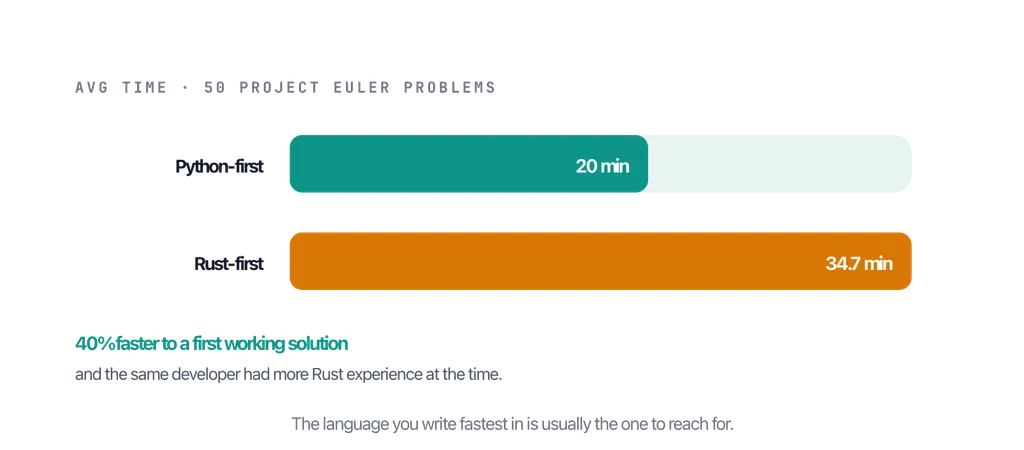
Let’s start with the most direct comparison I could find. Thor Kampefner - a developer experienced in Rust but rusty (pun intended) in Python solved 50 Project Euler problems in both languages, timing everything meticulously. The results?
Python-first implementations averaged 20 minutes. Rust-first implementations averaged 34.7 minutes.
That’s a 40% difference in development speed. And here’s the kicker - this developer had MORE experience with Rust than Python at the time of the study. Even with the deck stacked in Rust’s favor, Python still won on speed of initial development.
Thor found something even more interesting: any problem taking 35+ minutes in Rust could be solved faster by prototyping in Python first, then translating to Rust. Think about that. It’s literally faster to write the solution TWICE (once in Python, once in Rust) than to write it once in Rust directly.
Why? He hypothesized that “language minutia (e.g., references, mutability constraints, types) competes with attention toward the total solution, reducing developer productivity for complexity.” In other words, Rust makes you think about memory management when you should be thinking about the problem.
But wait, the Rust defenders cry, what about all those bugs Python lets through? Surely Rust’s type system and borrow checker save you time in the long run?
The 1% That Destroys All Arguments About Correctness
Here comes the uncomfortable truth for language zealots. UC Davis researchers analyzed 729 projects, 80 million lines of code, 29,000 developers, and 566,000 bug fixes across 17 languages on GitHub. Their finding?
Programming language accounts for less than 1% of the variance in defect rates.
Let that sink in. All that arguing about type systems, memory safety, and language features? It affects bugs by less than one percent. The study explicitly states: “One should take care not to overestimate the impact of language on defects. While these relationships are statistically significant, the effects are quite small.”
What actually matters? Process factors like project size, team size, and commit patterns “overwhelmingly dominate” any effects from language design. The researchers even suggest that the tiny effects they did find might be due to “other, intangible process factors, e.g., the preference of certain personality types for functional, static and strongly typed languages.”
Translation: Maybe Rust has slightly fewer bugs not because of the language, but because the kind of person who chooses Rust is more careful. Or maybe teams that can afford to use Rust have better processes. We don’t actually know.
So when someone tells you Rust will save you from bugs, show them this study. Good development practices matter 99 times more than your language choice.
What About Learning Curves?
“But Igor,” the Rust evangelists protest, “once you learn Rust, you’re just as productive!”
Multiple studies suggest otherwise. An analysis of the ISBSG dataset (the largest public repository of software project data) found that scripting languages consistently outperform systems programming languages in productivity metrics. Another empirical comparison found that scripting languages like Python are “more productive than conventional languages.”
The truth? That “once you learn it” moment might never fully arrive. Even experienced Rust developers report that Python feels faster for exploration and prototyping. The language genuinely does make certain tasks harder, not because you’re not smart enough, but because it forces you to think about problems that might not matter for your use case.
The Hybrid Approach
Here’s what’s actually happening in the real world while everyone argues online. According to JetBrains’ State of Python 2025 report, Rust usage for Python binary extensions jumped from 27% to 33% in one year - a 22% increase. At the 2025 Python Language Summit, core developers revealed that “somewhere between one-quarter and one-third of all native code being uploaded to PyPI for new projects uses Rust.”
The New Stack reports that this represents a key shift in how the Python ecosystem approaches performance optimization. Developers are increasingly choosing Rust over traditional C extensions - even I use Rust powered extensions for all my projects.
You know what this means? Smart teams aren’t choosing between Python and Rust. They’re using Python for what it’s good at (rapid development, glue code, business logic) and Rust for what it’s good at (performance-critical sections). Astral’s uv (Python package and project manager) - written in Rust to manage Python. Polars (data processing) - Python API, Rust core. Pydantic V2 (data validation) - Python interface, Rust engine. Ruff (Python linter) - 100x faster than the Python equivalent, written in Rust, used from Python.
This is the future. Not “Python vs Rust” but “Python with Rust.” The people actually building things have moved past the debate while the zealots are still fighting.
When Python Absolutely Dominates
After analyzing all this research, here’s when Python objectively wins:
You’re building I/O-bound applications. My analysis showed Python represents 0.1-0.5% of total request time for typical AI SaaS. When OpenAI takes 2 seconds to respond, nobody cares if your handler takes 5ms or 0.5ms.
You’re doing anything with AI or machine learning. Every new model, every new technique, every new paper implementation appears in Python first. Fighting this is like trying to do web development without JavaScript.
You need to ship fast and iterate. That 40% productivity advantage isn’t theoretical. It’s measured. It’s real. In startups, shipping 40% faster might be the difference between success and running out of money.
You need to hire. I can find ten qualified Python developers for every Rust developer. When you’re scaling a team, this matters more than any technical consideration.
Your performance bottlenecks are elsewhere. Database queries, network calls, third-party APIs - these dwarf language performance in 99% of applications. Fix your N+1 queries before worrying about language speed.
Rust is Better Than Python
Let’s be fair. Rust genuinely excels when:
Performance directly equals money at scale. Discord moved specific services from Go to Rust because garbage collection pauses were literally costing them users. They had millions of concurrent connections where every millisecond mattered.
You’re building systems software. Databases, operating systems, browsers - where millions of users benefit from every optimization and correctness is critical.
Memory usage is a real constraint. Embedded systems, high-frequency trading, game engines. When you’re counting bytes, Rust shines. Lovable went from 200 server instances to just 10 when they migrated from Python to Go (not even Rust!) - but critically, they reached a $2 billion valuation with Python first.
But notice something? These are all specialized cases. Most of us are building CRUD apps, data pipelines, and API integrations. We’re not Discord. We’re not building the next PostgreSQL. We’re trying to solve business problems.
The Dirty Secret of Every Successful Company
Want to know how actual successful startups choose languages? They don’t. They use what they know and ship.
Instagram’s founders chose Django because, as co-founder Mike Krieger said, “Django gave us that advantage — allowing us to focus on our product rather than reinventing the wheel.” They were a two-person team who needed to ship fast. They scaled to 1 billion users on Python.
Discord started with Python for their APIs because, as they explained in a 2018 Reddit AMA, “it’s a good general-purpose glue language for writing web APIs, with good database drivers, a nice concurrency model and a good wealth of 3rd party libraries.”
Then - and only then - when they hit real, measured bottlenecks, they optimized specific parts. Instagram kept Python but rewrote image processing in C. Discord kept Python for most things but rewrote specific services in Rust.
Dropbox? Mostly Python with performance-critical parts in Rust. Spotify? Java, Python, and C++ in different places. Google? Python, Java, C++, and Go for different things.
The pattern is clear: Start with what you know. Ship something. Measure real bottlenecks. Fix only what needs fixing. This approach builds billion-dollar companies while others debate language choices.
Your Tech Stack Is Not Your Personality

The developer who’s deeply invested in Rust being “better” has tied their professional identity to a technology choice. The Python developer who gets defensive about performance has done the same. You’re not your tech stack. You’re not smarter because you use Rust. You’re not more practical because you use Python. I wonder if people working in construction argue about the better hammer and put a brand beside their name.
The research shows that good engineers ship good software in any language. Bad engineers write bad software in any language. The language is almost irrelevant compared to the engineer using it.
A great Python team will outperform a mediocre Rust team. A great Rust team will outperform a mediocre Python team. The language matters so much less than the people and processes that it’s almost embarrassing how much time we spend arguing about it.
The Bottom Line That Matters
After reviewing hundreds of pages of research, analyzing real-world case studies, and cutting through the tribal BS, here’s what actually matters:
- You ship faster with the language you know than with the one you don’t
- Python ships working software faster than Rust
- Language choice affects defect rates by less than 1% in real-world applications
- Process and people matter 99x more than language
- Successful companies use multiple languages pragmatically
But here’s the real truth bomb: A language is just a tool. You don’t marry your hammer. You don’t put “Makita Enthusiast” in your LinkedIn bio. You pick the right tool for the job, use it to build something, and move on.
Your users don’t care what language you use. They care if your product solves their problems. Your investors don’t care about your type system. They care if you ship before the money runs out.
The developer who knows PHP inside-out will ship faster than the one learning Rust because it’s “better.” The team using boring Java with good practices will outperform the team using cutting-edge tech with chaos. The company with clear requirements beats the one with perfect type safety but no vision.
So here’s my challenge to you: Stop arguing about languages. Stop falling in love with tools. If you know Python, use Python and ship something. If you know Rust, use Rust and ship something. If you hit real, measured bottlenecks, grab the appropriate tool and fix them. But whatever you do, stop pretending your language choice makes you superior. The data doesn’t support it. The successful companies don’t care. And your users are waiting for solutions while you’re arguing about memory management.
Pick the best tool for your use case. Use it. Ship something. Don’t fall in love with it. When a better tool comes along for your next problem, use that instead. Use evidence to support your decision, not emotion - you’re supposed to be an engineer.
The best language is the one that ships. Usually, that’s the one you already know.
Want to ship your AI SaaS today instead of debating languages? FastroAI gives you production-ready Python/FastAPI with everything configured. Because shipping beats arguing.
References
- Project Euler Productivity Study: Python vs Rust
- A Large Scale Study of Programming Languages and Code Quality in GitHub
- An Empirical Comparison of Seven Programming Languages
- An empirical study on the effect of programming languages on productivity
- A comparative study of high-productivity high-performance programming languages
- JetBrains State of Python 2025
- Rust: Python’s New Performance Engine
- Discord: Why We’re Switching from Go to Rust
- How Instagram Originally Used Django
- How Instagram Scaled Its Infrastructure
- Discord Tech Stack Explanation
- Lovable: From Python to Go